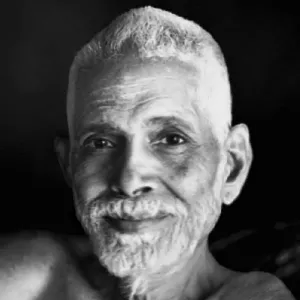
Biography
Ramana Maharshi was an Indian sage who, at the age of sixteen, experienced a profound spiritual awakening that revealed to him his true nature as pure awareness. Without any formal teaching or initiation, he spontaneously realized the Self and spent the remainder of his life at the holy mountain Arunachala in South India.
For over fifty years, seekers from around the world came to sit in his presence and receive his teachings. He spoke little, often communicating through silence, which devotees found more powerful than words. When he did speak, his teachings were remarkably simple and direct, always pointing back to the fundamental question of identity.
His life was characterized by extraordinary stillness, compassion, and accessibility. He treated all visitors equally—whether scholars, peasants, or animals—and his ashram became a refuge for seekers of truth. His teachings continue to influence spiritual seekers worldwide.
Teaching and methods
Self-inquiry (Atma Vichara): Ramana's primary teaching was the practice of asking "Who am I?" He taught that by persistently investigating the source of the "I"-thought, one discovers that the ego has no independent existence, revealing the ever-present Self. He also taught surrender to the divine as an alternative path, emphasizing that both methods lead to the same recognition of one's true nature as pure awareness.
Selected quotes
“ All bad qualities centre round the ego. When the ego is gone, Realisation results by itself. There are neither good nor bad qualities in the Self. The Self is free from all qualities. Qualities pertain to the mind only. ”
“ When one remains without thinking one understands another by means of the universal language of silence. ”
“ Our real nature is mukti. But we are imagining we are bound and are making various, strenuous attempts to become free, while we are all the while free. This will be understood only when we reach that stage. We will be surprised that we were frantically trying to attain something which we have always been and are. ”
— Be As You Are (Arkana)